
Short answer
You need one if your home has a check valve, backflow preventer or pressure-reducing valve on the water line, because heated water then has nowhere to expand. The model code requires pressure control in those closed systems. The tank's air charge must be set to your house water pressure, and a waterlogged tank must be replaced.
Key facts
- IRC P2903.4.2 requires a device for controlling pressure where a backflow preventer, check valve or similar device on a system with storage water heating lets thermal expansion raise the pressure.[1]
- Amtrol ships its standard Therm-X-Trol tanks pre-charged at 40 psi and says the pre-charge must be matched to the incoming supply pressure before installation.[2]
- Watts PLT-5, PLT-12 and PLT-20 tanks ship with a 20 psi air pre-charge, which its instructions say must be set to the system pressure before installation.[3]
- HomeGuide's 2025 range for replacing an expansion tank is $300 to $800.[5]
What an expansion tank does
Water grows when it heats. Amtrol's sizing table puts the growth at about 1.0% when water is heated from 40 F to 120 F[2]. For a 50-gallon tank, that is about half a gallon of extra water every heating cycle (our arithmetic).
In an "open" system, that extra water pushes back into the city main and nobody notices. Many homes are now "closed." A check valve, a backflow preventer or a pressure-reducing valve on the incoming line stops water from flowing backward. The expanding water has nowhere to go, so the pressure in the whole house rises until something gives. Usually that is the relief valve on the water heater, which starts to drip[1].
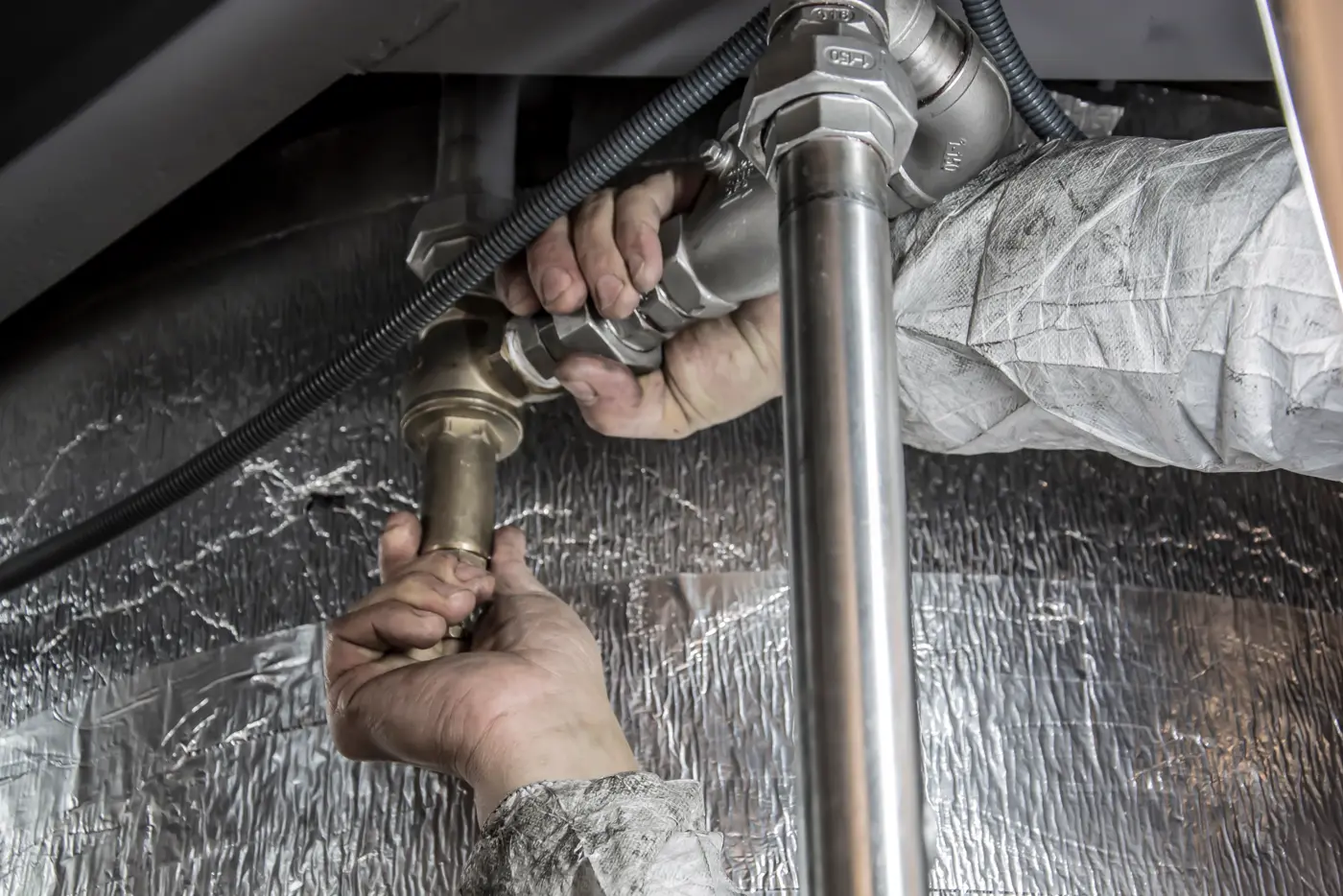
An expansion tank gives the extra water a place to go. It is a small steel tank on the cold line near the heater. Inside, a rubber bladder or diaphragm separates water from a cushion of compressed air. As the heater warms the water, the extra volume squeezes into the tank and compresses the air. When someone opens a hot tap, the air pushes that water back out[2].
When the code requires one
The International Residential Code, the model code many states and cities adopt, has two triggers[1]:
| Your system has | What the code says |
|---|---|
| A backflow preventer, check valve or similar device, with a storage water heater | A device to control the pressure from thermal expansion must be installed (P2903.4.2) |
| A pressure-reducing valve, on service lines up to 2 inches | A pressure control device is required where thermal expansion pushes pressure above the valve's setting (P2903.4.1) |
The code also caps static water pressure in a home at 80 psi and calls for a pressure-reducing valve above that[4]. Since that valve creates a closed system, homes with high street pressure often end up needing both.
In practice the "device" is almost always an expansion tank. Your city may have adopted a different code or an older edition, so the local rule is what counts. See expansion tank requirements.
Common sign you have a closed system: the relief valve started dripping after the water utility replaced your meter or after a plumber added a pressure-reducing valve. See relief valve dripping.
Why the air charge must match your water pressure
This is the step that gets skipped most often. Tanks come from the factory with a set air charge, and makers do not agree on what it is:
- Amtrol ships standard Therm-X-Trol tanks at 40 psi[2].
- Watts ships PLT-5, PLT-12 and PLT-20 tanks at 20 psi[3].
Both makers say the installer must set the air charge to the home's water pressure before the tank goes in[2][3]. Amtrol explains why: if a home has 70 psi of water pressure and the tank is left at 40 psi, house pressure squeezes water into the tank before any heating happens. That uses up the space the tank needs to absorb expansion. Amtrol says getting this wrong can contribute to early tank failure[2].
Watts adds two limits for its PLT tanks: do not set the air charge above 80 psi, and adjust it only when the system is at zero pressure[3]. If house pressure is above 80 psi, Watts says to add a pressure-reducing valve[3].
Sizing
Amtrol sizes its tanks from four inputs: the water heater's volume, the heater's temperature setting (which sets how much the water expands), the incoming line pressure, and the maximum pressure allowed[2]. A larger heater, a hotter setting or higher line pressure all call for a larger tank. For scale, Watts' PLT-5 holds 2.1 gallons and its PLT-12 holds 4.5 gallons[3]. A plumber picks the size from the maker's chart for your heater and pressure.
Signs an expansion tank has failed
An expansion tank can lose its air charge over time, or its bladder can tear. Then it fills with water ("waterlogs") and stops absorbing anything. Watts notes that any expansion tank may eventually leak and that its diaphragm is not separately serviceable[3].
| Symptom | What it suggests |
|---|---|
| Relief valve drips after heating cycles, even with a tank installed | Tank is waterlogged or its air charge is low |
| Water spits from the air valve when a plumber checks it | Bladder or diaphragm has failed; replace the tank |
| Rust, weeping seams or a wet fitting on the tank | Tank or connection is failing; replace it |
| Pressure gauge on a hose bib jumps well above normal during heating | Expansion is not being absorbed |
Many plumbers also tap the tank: a working tank sounds hollow at the air end. Treat that as a rough clue, not a test.
Safety notes
- Never cap or plug the relief valve or its discharge pipe to stop a drip. Watts' instructions say plainly: never plug a safety relief valve[3].
- An expansion tank holds water under pressure. Watts rates its PLT tanks to 150 psi and 200 F[3]. Adjusting the air charge means isolating and draining the tank, so leave it to a plumber if you are not comfortable with that.
- A tank full of water is heavy. Watts says the piping carries that weight, so the piping may need bracing[3].
What it costs
HomeGuide's August 2025 range for replacing an expansion tank is $300 to $800[5]. When a tank is added during a water heater replacement, its January 2026 guide lists $100 to $400[6]. Adding one while a plumber is already on site is usually the cheaper route. See expansion tank installation cost.
When to call a pro
- Your relief valve drips after heating cycles and you have no expansion tank, or have one that may be waterlogged.
- Your home pressure may be above 80 psi, or you have a new meter or pressure-reducing valve.
- An expansion tank shows rust, a leak, or water at the air valve.
- Any install or replacement, so the tank is sized, supported and pre-charged to your pressure.
More questions
Does a tankless water heater need an expansion tank?
The model code's backflow rule is written for systems with storage water heating equipment [1], and a tankless unit stores very little water. Local rules and the maker's manual can still call for one, so ask the plumber or your building department for your address.
Can I just add air to my old expansion tank?
Only if the bladder is intact, and only with the tank isolated and drained, which is plumbing work. Watts says its air charge should be adjusted only at zero system pressure [3]. If water comes out of the air valve, the bladder has failed and the tank needs replacing.
Sources
- IRC P2903.4 Thermal expansion control, International Code Council (via UpCodes). Accessed 2026-10-06.
- Sizing the Therm-X-Trol potable water expansion tank (MC10007), Amtrol. Accessed 2026-10-06.
- Installation instructions, potable hot water expansion tank models PLT-5, PLT-12, PLT-20, Watts. Accessed 2026-10-06.
- 2018 IRC P2903.3.1 Maximum pressure, International Code Council. Accessed 2026-10-06.
- Hot water heater repair cost (Aug 7, 2025), HomeGuide. Accessed 2026-10-06.
- How much does water heater installation or replacement cost? (Jan 2, 2026), HomeGuide. Accessed 2026-10-06.
Water Heater Facts is an information and referral service run by Strive LeadGen LLC. We may be paid by contractors when we connect a homeowner with one; that never changes what we publish. Found an error? Tell us. We review safety and legal reports within 2 business days and all others within 7 days.