
Short answer
Replace it when it seeps constantly with normal pressure and an expansion tank in place, will not reseat after testing, is corroded, or has been capped or tampered with. A drip after heating cycles usually points to thermal expansion, not a bad valve. Replacement is licensed-plumber work, typically $50 to $300 installed (HomeGuide, 2025).
Key facts
- Model code requires every water heater to have a combination temperature and pressure relief valve, or separate valves for each.[1]
- The temperature side must sense water in the top 6 inches of the tank and open at no more than 210 F.[2]
- A.O. Smith tells owners to operate the T&P valve once a year and to inspect it every 2 to 4 years, per the label on the valve.[6]
- HomeGuide's 2025 range for relief valve replacement is $50 to $300; the part alone runs about $10 to $25.[8]
Stop and call now if
- The valve is releasing a steady stream of very hot water or steam.
- The tank is rumbling and the hot taps run scalding hot.
A.O. Smith says a large amount of hot water from the discharge pipe may mean the tank is overheating. Its manual tells owners to shut off the heat source and call a qualified person[6]. If you are not sure how to do that safely, or you smell gas, leave the house and call your gas utility or 911 from outside. Stay clear of the pipe while it is releasing.
What the T&P valve does
The temperature and pressure relief valve is the last safety device on a tank water heater. It sits on the top or upper side of the tank with a pipe running down toward the floor. If the thermostat, gas control or element sticks on, the tank keeps heating and pressure climbs. The valve opens and dumps hot water before the tank can fail.
The model code is specific about it:
| Requirement | What the code says |
|---|---|
| Valve required | A combination temperature and pressure relief valve, or a separate valve for each[1] |
| Temperature setting | Sensing element must monitor the top 6 inches of the tank; opens at no more than 210 F[2] |
| Pressure setting | Opens at no more than 150 psi, at least 25 psi above system pressure, and never above the tank's rated working pressure[3] |
| No shutoffs | No check or shutoff valve between the relief valve and the tank, or between the valve and the end of its discharge pipe[4] |
| Discharge pipe | Full size, drains by gravity, ends where people can see it, no threaded end, no valves or tee fittings[5] |
A.O. Smith adds that its valves are certified to the ANSI Z21.22 standard for hot water relief valves, and that the valve's relief pressure must not exceed the working pressure on the heater's rating plate[6]. That is why a plumber matches the replacement to the rating plate rather than grabbing any valve off the shelf.
Signs the valve itself has failed
A relief valve that opens is not always a bad valve. Most of the time it is reacting to something else.
| Symptom | Most likely cause | Valve replacement needed? |
|---|---|---|
| Drips during or right after heating, then stops | Thermal expansion in a closed system | Usually no; an expansion tank is the fix[7] |
| Drips at random times | Street pressure too high | Usually no; a pressure-reducing valve set to 50 to 60 psi is the fix[6] |
| Steady flow, very hot water or steam | Tank overheating from a failed control | Yes, along with the failed control |
| Slow seep that never stops, pressure normal, expansion tank working | Debris on the seat or a worn valve | Often yes[6] |
| Will not close after the test lever is lifted | Mineral buildup on the seat | Yes |
| Crusty white or green buildup, rust around the threads | Corrosion and slow leakage | Yes |
| Valve or pipe has been capped, plugged or reduced | Unsafe installation | Fix immediately |
A.O. Smith's own checklist for a dripping valve: if the water pressure is between 50 and 60 psi, a thermal expansion tank is installed and properly charged, and the valve has been cleared of debris, but it still drips, the valve may be broken and a qualified person should replace it[6].
What a homeowner can safely check
- Timing of the drip. Right after hot water use points to expansion. Around the clock points to the valve or high street pressure.
- Is there an expansion tank? Look for a small tank on the cold line near the heater.
- Where the pipe ends. It should end in the open, near the floor or over a pan or drain, where you can see it[5]. If it runs into a wall or has a cap on it, call a plumber.
- The label on the valve. It lists the maintenance schedule the valve maker expects.
About the test lever. Both Rheem and A.O. Smith list a yearly test as owner maintenance. Rheem says to lift and release the lever at least once a year so a few quarts drain through the discharge line to an open drain[7]. A.O. Smith warns that the water may be hot enough to cause severe burns, so no one should stand in front of the outlet[6]. Because the discharge is scalding and an old valve may not reseat, many homeowners have a licensed plumber do this test during a tune-up. A valve that keeps running after a test needs a plumber the same day.
Why replacement is plumber work
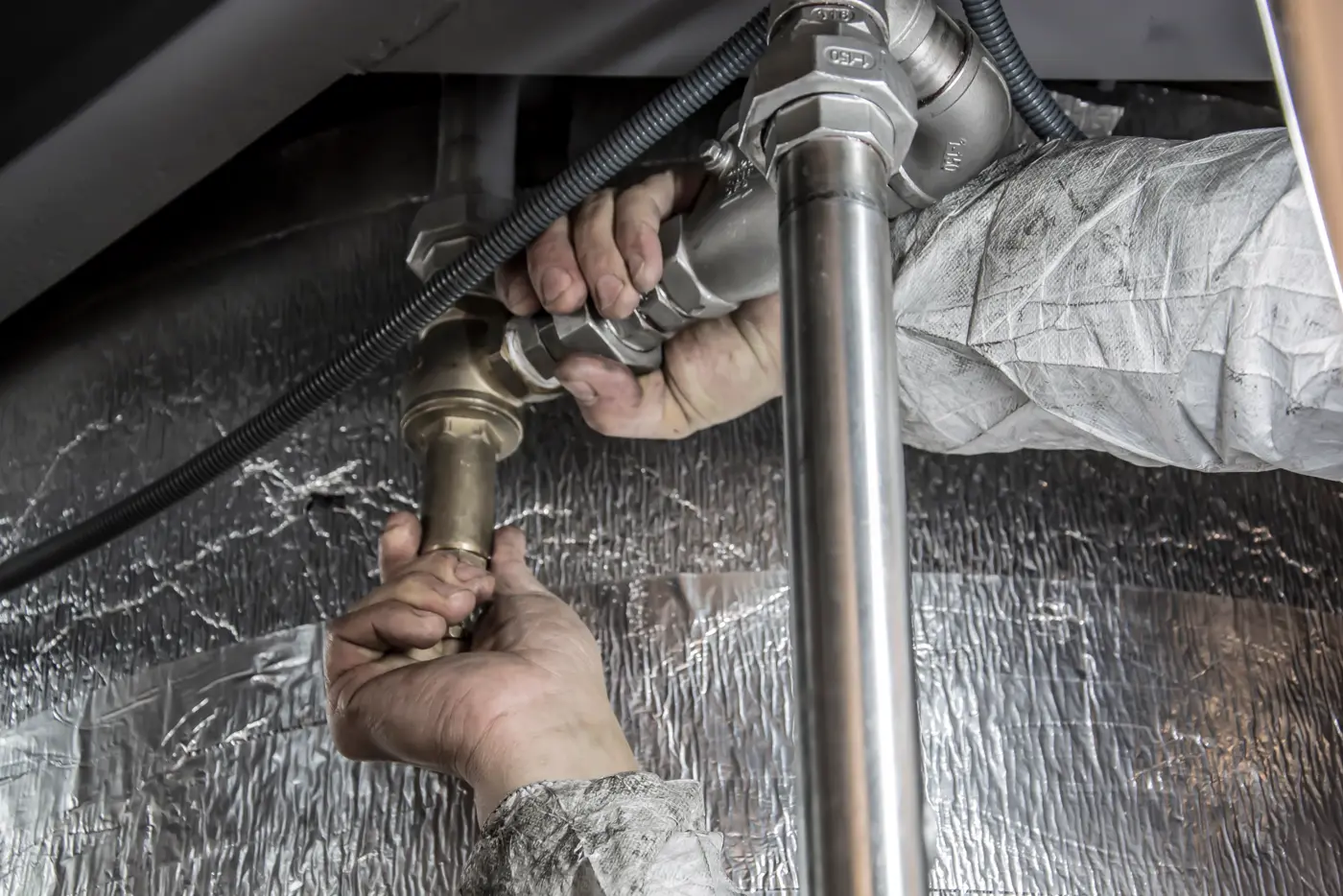
Swapping the valve means shutting off the heat source and water, draining the tank below the valve, unthreading a fitting on a pressure vessel, and sealing a new valve that matches the tank's rating. The discharge pipe then has to meet code[5]. A.O. Smith also tells installers never to reuse an old T&P valve on a new heater[6]. A mistake leaves the tank without its last line of defense. Have an independent licensed plumber do it, and ask them to find out why the old valve was opening.
What it costs
| Source (date) | Item | Range |
|---|---|---|
| HomeGuide (Aug 2025) | Relief valve replacement, installed | $50 to $300[8] |
| HomeGuide (Aug 2025) | Relief valve, part only | $10 to $25[8] |
| Modernize (Aug 2026) | T&P valve replacement, including a discharge line check | $150 to $350[9] |
HomeGuide notes that service call fees of $50 to $200 may apply on top[8]. National ranges are not quotes. If an expansion tank or pressure-reducing valve is the real fix, that adds to the bill. See relief valve dripping for those costs.
When to call a pro
- Any steady flow, very hot water or steam from the valve.
- A valve that will not reseat after testing, or that seeps around the clock.
- A discharge pipe that is capped, plugged, undersized or runs somewhere you cannot see.
- Any replacement of the valve or its discharge pipe.
More questions
Can I reuse the old T&P valve on a new water heater?
A.O. Smith says not to. Its manual tells installers to use the new valve that ships with the heater and never to reuse an old one.
Is a dripping relief valve dangerous?
The drip itself is the valve doing its job. The danger is capping or plugging it to stop the drip. A.O. Smith warns that an explosion could occur if the valve or its discharge pipe is blocked.
Sources
- IRC P2804.1 Relief valves required, International Code Council (via UpCodes). Accessed 2026-10-06.
- IRC P2804.4 Temperature relief valves, International Code Council (via UpCodes). Accessed 2026-10-06.
- IRC 2018 P2804.3 Pressure relief valves (South Carolina Residential Code 2018, Chapter 28), International Code Council (via UpCodes). Accessed 2026-10-06.
- IRC P2804.6 Installation of relief valves, International Code Council (via UpCodes). Accessed 2026-10-06.
- IRC P2804.6.1 Requirements for discharge pipe, International Code Council (via UpCodes). Accessed 2026-10-06.
- Residential gas water heater installation instructions and use and care guide (atmospheric Ultra Low NOx, FVIR), A.O. Smith. Accessed 2026-10-06.
- Use and care manual, residential gas low NOx FVIR water heaters (AP23698), Rheem Manufacturing. Accessed 2026-10-06.
- Hot water heater repair cost (Aug 7, 2025), HomeGuide. Accessed 2026-10-06.
- Water heater repair cost 2026 (updated Aug 12, 2026), Modernize. Accessed 2026-10-06.
Water Heater Facts is an information and referral service run by Strive LeadGen LLC. We may be paid by contractors when we connect a homeowner with one; that never changes what we publish. Found an error? Tell us. We review safety and legal reports within 2 business days and all others within 7 days.