
Short answer
Close the cold water supply valve above the heater, then turn off the power at the breaker (electric) or set the gas control to off per the label or manual (gas). Mop up and take photos. Then find where the water starts: top fittings, relief valve, drain valve, or the tank itself. Smell gas? Leave and call from outside.
Key facts
- A.O. Smith says to turn off the power or gas before any inspection and close the dedicated shut-off valve on the cold water line.[1]
- Rheem says leaks from the bottom often signal tank corrosion that requires replacement.[6]
- Modernize (Aug 2026) lists leak repairs at valves, fittings or lines at $150 to $600 nationally.[8]
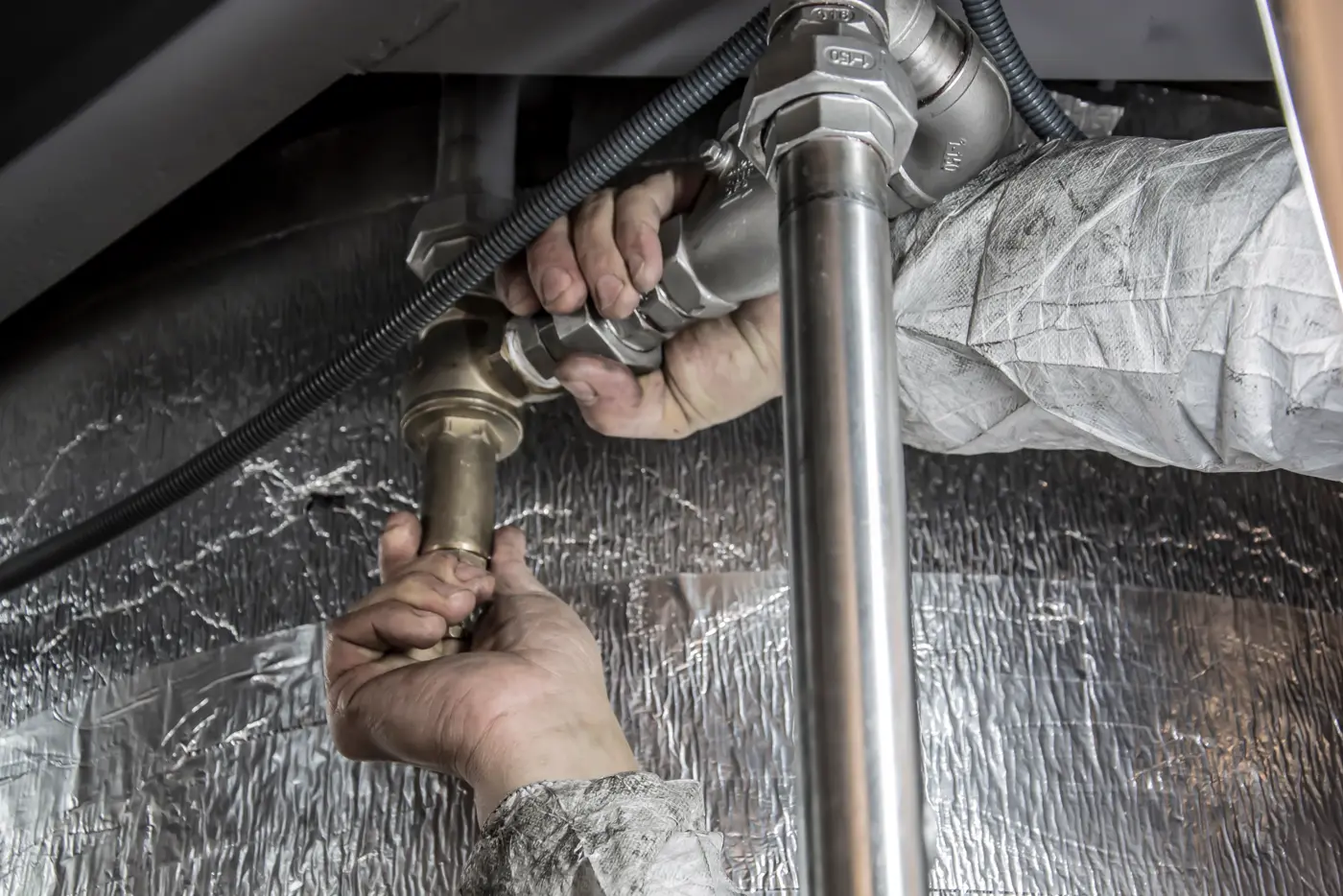
What to do right now
If you smell gas, skip every step below. Leave the house, do not touch light switches, and do not use a phone inside. Call the gas utility or 911 from outside or from a neighbor's phone[4]. See gas smell near a water heater.
If there is no gas smell, do these four things in order:
- Shut off the water to the heater. Close the shut-off valve on the cold water line, usually on the pipe above the heater's inlet[1][2]. This stops new water from feeding the leak.
- Shut off the heat source. Electric: switch off the water heater breaker. There may be more than one[2]. Gas: turn the unit off using the shutdown steps on the label on the heater or in the owner's manual. A.O. Smith says to turn off power or gas before any inspection[1].
- Protect the area. Move stored items, put down towels, and use a bucket or wet vac. If water has reached the burner area, the controls or any wiring, stay back and call a pro.
- Take photos. Rheem suggests photographing visible leaks, rust or unusual condensation before you call a plumber[6]. Photos help a plumber tell the cause before the visit.
Keep the heater off while the supply valve is closed. Rheem's electric manual says not to turn the heater on unless the tank is full, and not to turn it on with the cold supply valve closed[3].
Where is the leak coming from?
Dry everything first. Then watch where water shows up first. Water runs down the outside of the jacket, so a leak at the top often ends up as a puddle at the bottom.
| Where you see water | Likely cause | Can it wait? | Who fixes it | Read more |
|---|---|---|---|---|
| Top: supply lines, inlet and outlet fittings, the relief valve threads, the anode port | Loose fitting or connector, worn connector, a loose anode or debris in its threads[1][5] | A slow drip can usually wait a day or two with the water off. A spray cannot | A licensed plumber. Gas units: always a pro | Leaking from the top |
| Bottom: drain valve | Valve not closing fully. A.O. Smith says replacement is usually the best fix[1] | Often, if it is a slow drip into a pan or bucket | A licensed plumber | Leaking from the bottom |
| Bottom: beads of water, sizzling under a gas burner | Condensation after a cold refill. Normal, and it fades as the tank heats[4] | Yes. Watch it for a few hours | No one, if it stops. A plumber if it keeps going | Leaking from the bottom |
| Bottom: from under the jacket, none of the above | Tank corrosion. Rheem says this often requires replacement[6] | No. Plan a replacement soon | A licensed plumber (replacement) | Leaking from the bottom |
| Relief valve or its discharge pipe | High pressure or temperature in the tank[1] | Not if it releases hot water or steam. Shut off and call | A licensed plumber. Never cap the valve | Relief valve dripping |
| Tankless unit: under the cabinet or from the condensate drain | Loose water connections, a blocked condensate line, or a leak inside the heat exchanger[7] | No, if water is inside the cabinet | A licensed plumber or the brand's service provider | Rinnai error codes |
Electric tanks have one more spot. Rheem's service bulletin lists heating element failure as a common leak source on electric units, with rust or water trails around the element cover[5]. Element work means draining the tank and opening an electrical compartment, so leave it to a pro.
Tankless clues. Rinnai's troubleshooting guide notes that liquid coming out of the condensate drain while the unit is not running is a common sign of a leaking heat exchanger. Some Rinnai models show code 79 when an internal leak sensor detects water[7].
Can I still use water if my water heater is leaking?
Usually yes, for cold water. In most homes the shut-off valve on the heater's cold inlet isolates only the heater. Toilets and cold taps elsewhere in the house still work. You will not have hot water until the heater is repaired or replaced.
Two cautions. First, if you cannot reach the heater's valve, or the leak is heavy, close the main water shut-off to the house. Then nothing in the house will have water. Second, do not restart the heater with the supply closed or the tank partly empty[3].
If the leak is only at a fitting and you need hot water for a day, ask a plumber before reopening the supply. Running a leaking unit means more water on the floor.
Is a leaking water heater dangerous?
It can be. The risks, from most to least common:
- Water damage. Slow leaks rot subfloors and drywall. Rheem notes that small amounts of condensation are normal, but pooling water indicates a problem[6].
- Water on electrical parts. Rheem's electric manual says that if a heater has been through a flood, turn off the power and water and do not run it again until qualified service personnel check it[3].
- Overheating. A relief valve that releases hot water or steam is a sign of excess temperature or pressure[1]. Bradford White says that if overheating occurs or the gas supply fails to shut off, turn off the manual gas control and call a qualified service technician[4].
- Gas. A gas smell is an emergency, separate from the leak. Follow the steps at the top of this page.
Leaks rarely fix themselves. A.O. Smith says a leak at the base is often the first sign of a serious problem[1].
What a leak usually costs
National ranges only. Your quote depends on the cause, your area, and the heater.
| Repair | Range | Source |
|---|---|---|
| Leak repair at valves, fittings or lines | $150 to $600 | Modernize, Aug 2026[8] |
| Relief valve replacement | $150 to $350 | Modernize, Aug 2026[8] |
| Anode rod replacement | $200 to $500 | Modernize, Aug 2026[8] |
| Like-for-like 40 to 50 gallon gas tank replacement | $2,600 to $5,050 | ProjectCostPro, 2026[9] |
| Like-for-like 40 to 50 gallon electric tank replacement | $2,550 to $4,650 | ProjectCostPro, 2026[9] |
Modernize lists a tank leak or tank failure as "often replacement" rather than repair[8]. Rheem's rule of thumb: replace rather than repair if the repair costs more than 50% of a new heater, if you have needed several repairs in the past two years, or if the unit is close to or over 10 years old and having issues[6].
For price drivers, see the replacement cost guide. To weigh age and repair history, see repair or replace.
When to call a pro
- Water is coming from the tank body or from under the jacket.
- The relief valve is releasing hot water or steam, or a steady stream.
- Water has reached the burner, gas controls, wiring or the electrical panel.
- You dried everything, watched for an hour, and still cannot find the source. An independent licensed plumber in your area can find it and quote the fix.
More questions
Can a new water heater leak?
Yes. Rheem's service bulletin says leaks reported within 1 to 4 months of a unit's production are most likely a loose component, a failed component, or an installation problem, not a failed tank. Call the installer first and ask about their workmanship warranty.
Should I drain the tank myself?
Rheem's urgent-help steps include draining through a garden hose at the drain valve, and warn that the water may be hot. If the leak is small and the supply is off, there is often no need. If you are not comfortable with it, leave draining to a licensed plumber.
Can a leaking tank be sealed?
No. A leak from the tank body means the steel has corroded through. Rheem and A.O. Smith both point to replacement for tank corrosion, not repair.
Sources
- Why is my water heater leaking?, A. O. Smith. Accessed 2026-10-15.
- Urgent help, Rheem Manufacturing. Accessed 2026-10-15.
- Use & Care Manual: Electric Residential Water Heaters with Electronic Control (AP21980 Rev 02), Rheem Manufacturing. Accessed 2026-10-15.
- Installation and Operation Instruction Manual: Direct Vent Gas Water Heater (238-54724-00E), Bradford White. Accessed 2026-10-15.
- Technical Service Bulletin: Water Leak Checks for Residential Products (Feb 11, 2019), Rheem Manufacturing. Accessed 2026-10-15.
- What to do before calling a plumber or replacing your water heater (Dec 1, 2025), Rheem Manufacturing. Accessed 2026-10-15.
- Troubleshooting Tankless Water Heater Diagnostic Codes (100000652), Rinnai. Accessed 2026-10-15.
- Water heater repair cost in 2026 (updated Aug 12, 2026), Modernize. Accessed 2026-10-15.
- Water heater replacement cost: 2026 by size and fuel (reviewed Jul 2026), ProjectCostPro. Accessed 2026-10-15.
Water Heater Facts is an information and referral service run by Strive LeadGen LLC. We may be paid by contractors when we connect a homeowner with one; that never changes what we publish. Found an error? Tell us. We review safety and legal reports within 2 business days and all others within 7 days.