
Short answer
Most top leaks come from the plumbing, not the tank: a loose or worn supply connector, a fitting on the cold inlet or hot outlet, the relief valve threads, or the anode rod port. On gas units, condensation after a cold refill can look like a leak. Most of these are repairable by a licensed plumber.
Key facts
- A.O. Smith says that if a leak is at the top of the heater, inspect the pipe fittings and connections first.[1]
- Rheem's service bulletin says an anode on top of the unit can be loose or have debris in its threads, creating a leak path under the top pan or the inlet and outlet caps.[2]
- Bradford White's gas manual says condensation on a cold-filled tank is normal, does not indicate a leak, and disappears when the tank heats.[3]
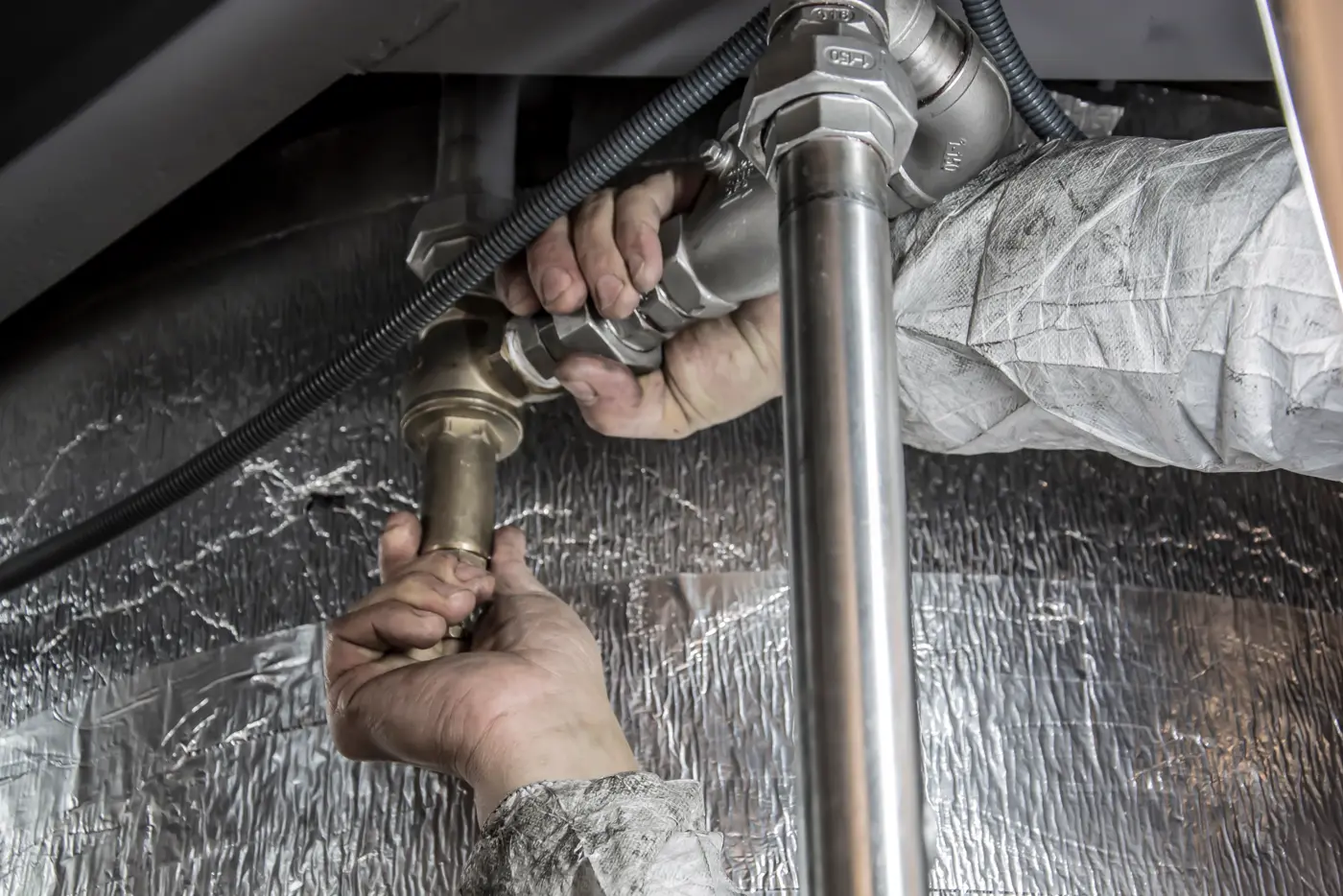
First, stop the water
Close the shut-off valve on the cold water line above the heater, and turn off the breaker (electric) or turn the unit off per the label (gas)[1]. If you smell gas, do none of this: leave the house and call the gas utility or 911 from outside[3]. The leaking water heater hub has the full first-steps list.
The six places a top leak starts
| Spot on top | What it is | Common cause | Who fixes it |
|---|---|---|---|
| Supply connectors | Flexible lines from the shut-off valve to the heater | Loose nut, worn washer, corroded or kinked line | A licensed plumber |
| Cold inlet and hot outlet nipples | Short threaded pipes in the tank top, often dielectric | Loose threads, a corroded fitting | A licensed plumber |
| Dielectric unions | Fittings that separate copper from steel | Worn seal or corrosion | A licensed plumber |
| Relief valve threads | Where the T&P valve screws into the tank | Thread seep, or the valve itself opening | A licensed plumber. Never cap the valve |
| Anode rod port | A hex head on top, or combined with the hot outlet | Loose anode or debris in the threads[2] | A licensed plumber or authorized service provider |
| Condensation (gas units) | Moisture forming on a cold tank | Normal after a cold refill[3] | No one, if it stops |
Supply connectors
Most tanks connect to the house with flexible water connectors. They are cheap parts, but they hold full house pressure. Look for a drip at the nut, green or white crust, or a kink. A.O. Smith says to inspect the fittings and connections first when a leak is at the top, and that a loose pipe fitting can sometimes be gently tightened with a wrench. It also warns that overtightening can damage the fitting and make the leak worse[1]. If a gentle snug does not stop it, stop there and call a plumber.
Never put a wrench on any fitting on the gas line or the gas control. That is a job for a licensed plumber only.
Dielectric nipples and unions
Many tanks use dielectric fittings at the cold inlet and hot outlet to separate the steel tank from copper house piping. Bradford White's gas manual, for example, describes its inlet and outlet as dielectric waterway fittings with 3/4 inch NPT male threads, and warns not to apply heat to nipples that contain a plastic liner[3]. That warning matters: a fitting damaged during a past soldering job can seep later.
Rheem's electric manual also notes that dielectric unions and flexible connectors can leave the heater electrically isolated from the piping[4]. That is one more reason this work belongs with a pro who can check grounding.
The relief valve threads
The temperature and pressure relief valve (T&P valve) sits on the top or upper side of the tank. Water can come from its threads or from the valve opening. A.O. Smith says leaks at the side often come from this valve and are usually caused by excess pressure or temperature[1]. If water comes out the discharge pipe, see relief valve dripping. Relief valve replacement is not a homeowner job.
The anode rod port
The anode is a metal rod that corrodes so the tank does not. Rheem's service bulletin says an anode can be loose or have debris in its threads, which shows up as water under the top pan or under the inlet and outlet caps. Its repair method is for a service provider to tighten the anode or replace it, and to re-tap damaged tank threads[2]. Some heaters combine the anode with the hot outlet nipple[3]. A.O. Smith says anode rods usually last 3 to 5 years[1]. More in our anode rod guide.
Condensation on gas units
Gas tanks often "sweat" after a big draw of cold water. Bradford White says condensate forms on the cool tank surface whenever it fills with cold water, drips onto the burner with a sizzling sound, and disappears once the tank heats[3]. Rheem adds that if condensation keeps going, check the piping and fittings for a real leak[4].
What you can safely check
Stick to three things: look, dry, watch.
- Look. Use a flashlight. Note which fitting is wet and whether there is crust or rust.
- Dry. Wipe the whole top and the connectors. Wrap a paper towel around each fitting.
- Watch. Check back in an hour. The first towel that gets wet points to the source. Water that shows up only during heating, then stops, may be condensation.
Do not remove the top cover, cut foam, pull the anode, or touch the gas control. Rheem's bulletin assigns anode work to a service provider[2].
A new heater leaking from the top
Rheem's service bulletin says leaks reported within 1 to 4 months of a unit's production are most likely a loose component, a failed component, or an installation problem[2]. Call the installer first.
What it costs
Modernize's August 2026 national ranges: leak repair at valves, fittings or lines $150 to $600, relief valve replacement $150 to $350, and anode rod replacement $200 to $500[5]. Most top leaks fall in those ranges. A leak from the tank body is a replacement, covered on the leaking water heater hub.
When to call a pro
- Water keeps coming back after you dry the top and gently snug a water fitting.
- The leak is at the relief valve, the anode port, or anywhere near the gas line or gas control.
- You see rust or crust on the tank top, not just on a connector.
- The heater is new and leaking: call the installer.
More questions
How do I change a water heater supply line?
The supply line is the short flexible connector between the shut-off valve and the heater's inlet or outlet. Swapping one means shutting off and depressurizing the system and sealing threaded joints that hold full water pressure. Most homeowners have a licensed plumber do it, and on gas units the plumber can check the gas side at the same visit.
My A.O. Smith water heater is leaking from the top. What could be causing this?
A.O. Smith's own guidance is to check the pipe fittings and connections on top first. A loose fitting is a common cause. Leaks at the side often come from the relief valve. If the water appears only right after a cold refill on a gas unit, it may be condensation that stops once the tank heats.
Sources
- Why is my water heater leaking?, A. O. Smith. Accessed 2026-10-15.
- Technical Service Bulletin: Water Leak Checks for Residential Products (Feb 11, 2019), Rheem Manufacturing. Accessed 2026-10-15.
- Installation and Operation Instruction Manual: Direct Vent Gas Water Heater (238-54724-00E), Bradford White. Accessed 2026-10-15.
- Use & Care Manual: Electric Residential Water Heaters with Electronic Control (AP21980 Rev 02), Rheem Manufacturing. Accessed 2026-10-15.
- Water heater repair cost in 2026 (updated Aug 12, 2026), Modernize. Accessed 2026-10-15.
Water Heater Facts is an information and referral service run by Strive LeadGen LLC. We may be paid by contractors when we connect a homeowner with one; that never changes what we publish. Found an error? Tell us. We review safety and legal reports within 2 business days and all others within 7 days.